Before the Water Lilies: Claude Monet's Early Caricatures


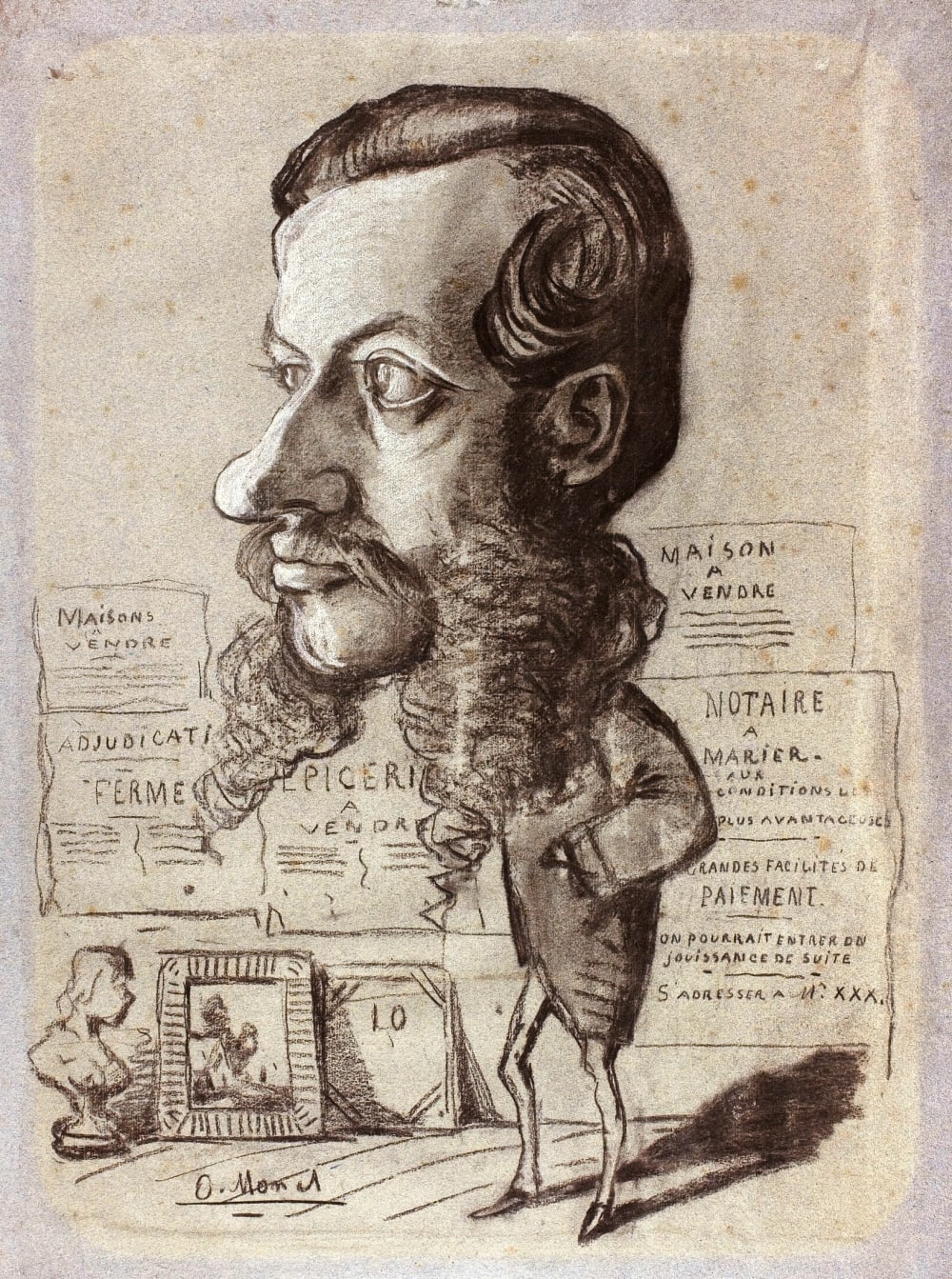
Long before he was the painter of haystacks, cathedrals, and the great water-lily panels, Claude Monet was a teenager with a sharp eye and a sharper pencil, making a tidy living off the vanity of his neighbors. In the Norman port of Le Havre in the late 1850s, the work that made the young Monet locally famous was not landscape at all but caricature: deft, slightly unkind cartoons of local notables and minor celebrities, displayed in a framing shop's window where passersby would stop to gawk and, often enough, to recognize themselves.
By his own later telling, it was a roaring success. “At fifteen,” Monet remembered in an interview with the Paris newspaper Le Temps nearly half a century later, he was among the best-known artists in town. He charged twenty francs a head — roughly two hundred euros in today's money — and on a good day could turn out seven or eight. “If I had continued,” he claimed, “I would have been a millionaire.”
The boast says as much about the older Monet's frustrations selling Impressionism as it does about the real money in portraits-charge. But the caricatures were no idle hobby. The art historian Rodolphe Walter memorably described them as Monet's “clandestine apprenticeship” — the first move toward an art career by the son of a Le Havre family in the ship-chandlery and grocery trade, made partly in defiance of a father who had other plans.
The surviving sheets show a remarkably confident hand for a boy in his mid-teens. The earliest, dated around 1855–56, are of anonymous types whose names have slipped away: The Man with the Big Cigar, The Man in the Small Hat, The Man with a Large Nose. The formula is consistent and shrewd — an outsized, closely observed head balanced on a small, briskly drawn body, the whole thing pitched to flatter the sitter's friends while gently puncturing the sitter. It is, in miniature, the caricaturist's eternal bargain.

Some of the sheets are frankly borrowed. A drawing of the journalist Auguste Vacquerie was lifted more or less wholesale from the great Parisian caricaturist and photographer Nadar, and another, of the actor-playwright Mario Uchard, follows Étienne Carjat. Copying the masters of the genre was exactly the kind of self-education the phrase “clandestine apprenticeship” implies.

The named portraits

The most interesting works are the ones where Monet drew people he knew and gave the joke a local edge. His 1858 caricature of Léon Manchon — treasurer of Le Havre's Société des amis des arts and a working notary — catches the man's likeness while sketching, in the background, both his legal trade and his appetite for the arts. It is portraiture and biography compressed into a single comic page.

The strangest of the group is the 1858 Caricature of Jules Didier, which depicts the recent Prix de Rome winner as a “Butterfly Man,” a winged dandy being led along on a leash by a small dog. Monet scholars have never fully agreed on what the imagery is supposed to mean, which is part of its charm — proof that even at eighteen the artist had a streak of the surreal.
More plainly barbed is his portrait of Henri Cassinelli, a fellow hopeful for an 1858 municipal art subsidy. Monet captioned it “Rufus Croutinelli,” a slightly labored pun on croûte, French studio slang for a bad daub. The joke has an undertone of sour grapes: neither young man got the grant. Monet would have to find another way to Paris.

How caricatures bought a career
That other way was, in the end, the caricatures themselves. The roughly two thousand francs Monet earned from these comic portraits — on the order of twenty thousand euros today — gave him the independence to move to Paris and begin training as a painter, against his father's wishes. (A pension from his well-off aunt, Marie-Jeanne Lecadre, with whom he had lived since his mother's death in 1857, helped too.)
There may have been a subtler dividend as well. In the same Le Temps interview, Monet recalled that it was while loitering at that framing-shop window, admiring his own admirers, that he first noticed the seascapes of Eugène Boudin hanging nearby. Boudin — soon his mentor — would take him out to paint en plein air for the first time and set the course of everything that followed. And it is tempting, if perhaps too neat, to see in the speed of the caricature a foretaste of Impressionism itself: the ambition to seize not the laborious likeness of a thing but its essence, fast.
A note for collectors
Here is the hard truth for anyone hoping to hang an early Monet caricature on the wall: you almost certainly can't. These are not works that circulate. The most significant surviving group is held at the Art Institute of Chicago, which owns roughly a dozen of the drawings — many of them gifts of Carter H. Harrison IV (1860–1953), a five-term mayor of Chicago and avid collector. The Art Institute, which in 1903 became the first American museum to buy a Monet painting, today holds the largest body of his work outside Paris, and the caricatures are a quiet jewel within it.
Because so few examples exist outside institutional walls, the caricatures rarely surface at auction, and there is no established market price the way there is for Monet's oils — single canvases of which have crossed sixty and even a hundred million dollars in recent sales. A drawing with secure provenance and a credible link to the Le Havre years would be a genuine event, of interest to museums as much as to private buyers, and would be valued far more for its rarity and biographical weight than for any comparable “sold” record. For the rest of us, the practical route is the print and reproduction market: the sheets are in the public domain, freely available in high resolution through the Art Institute and the Public Domain Review, and they make for unexpectedly charming framed pieces — a glimpse of a giant before he became one.
It is a useful corrective to the postcard version of Monet, all serene gardens and dappled light. Before the lilies, there was a clever, ambitious, slightly mercenary teenager selling laughs at twenty francs apiece — and parlaying them, brushstroke by brushstroke, into one of the most consequential careers in the history of painting.
More from the framing-shop window
A few more of the anonymous “types” Monet turned out by the handful, ca. 1855–56:


Sources and further reading: The Public Domain Review, “Doing Impressions: Monet's Early Caricatures”; The Art Institute of Chicago, “Early Caricatures” (Online Scholarly Catalogue); The Art Institute of Chicago, “Monet and Chicago”; DailyArt Magazine, “Caricatures by the Master Claude Monet”.


