

The Period at a Glance
La Chinoiserie
| Dates | c. 1670–1790 · peak c. 1750 under Louis XV · revived c. 1860–1920 |
| Key figures | Louis XIV · Madame de Pompadour · Jean-Baptiste Pillement |
| Key makers | Rouen & Nevers faïence · Chantilly & Mennecy porcelain · Beauvais tapestry · Vincennes–Sèvres |
| The tell | An imagined East — pagodas, parasols, long-tailed birds and blossoming branches, drawn from fantasy rather than observation and floated in airy asymmetry |
| Where to see it | Château de Chantilly (Grande Singerie) · Musée des Arts Décoratifs · Château de Versailles · V&A, London |
Chinoiserie is the most enchanting misunderstanding in the history of French taste. It is not Chinese art, and it was never meant to be; it is Europe’s dream of an East that most of the people who fell in love with it would never see — a fantasy assembled from lacquer screens unpacked on the Rouen quays, from blue-and-white porcelain that arrived as ballast in the holds of the Compagnie des Indes, from Jesuit letters and travellers’ tales and the odd painted fan. Out of these fragments the French built an imaginary country of pagodas and parasols, of mandarins fishing from impossible bridges and long-tailed birds perched on branches that obey no botany on earth. The word itself — from chinois, Chinese — carries the confession inside it: this is the French idea of China, and its beauty lies precisely in the distance between the dream and the place.
For roughly a century and a quarter — from the 1670s, when the taste first took architectural form at Versailles, through its rococo apogee under Louis XV, to the eve of the Revolution — chinoiserie was the recurring daydream of the French decorative arts, and it left its mark on nearly everything a well-appointed interior contained: the faïence on the table, the porcelain in the cabinet, the silk on the walls, the tapestry behind the chair, the lacquer of the commode, the very trees in the garden. To learn to read it is to learn one of the master keys of French style, because chinoiserie is where French craftsmanship, French wit, and French appetite for the exotic meet on a single decorated surface.
From the Trade Route to the Trianon: How the East Came to France, 1660–1700
The taste began, as tastes so often do in France, with the king. Louis XIV had absorbed the enormous cargoes of Chinese and Japanese porcelain that were reaching Europe through the Dutch and the newly chartered Compagnie des Indes, and in 1670 he ordered something no European monarch had built before: the Trianon de Porcelaine, a suite of pavilions in the grounds of Versailles, raised for Madame de Montespan and sheathed in blue-and-white ceramic tile in what the court understood to be the Chinese manner. In the absence of any European source of true porcelain, the tiles were faïence — tin-glazed earthenware — supplied by the potteries of Delft, Nevers, and above all Rouen, where Colbert, the king’s finance minister, had been protecting and commissioning the faïenciers since the 1660s. The building was a fantasy in every sense, its glazes cracking in the first hard winters, and Louis had it demolished within two decades. But the idea outlived the structure: the East could be summoned into a French garden, and French makers could supply the summoning.
What the Trianon established, the faïence workshops carried into every dining room in the kingdom. Rouen and Nevers painted blue-and-white wares whose borders and reserves drank deeply from Chinese export porcelain and, after about 1720, from the coloured Japanese Kakiemon palette of soft iron-red, blue-green, and gold. This is the ground floor of French chinoiserie, and the place most collectors first meet it: a Nevers plate with a lone Chinese figure beneath a parasol, a Rouen bowl edged in a lambrequin border that owes as much to Chinese cloud-scrolls as to French lace.
The Grammar of the Imagined East
Chinoiserie has a vocabulary, and once you have it the style announces itself across every medium. Look for the pagoda with its upturned, bell-hung eaves; the fretwork railing and the zig-zag bridge; the parasol and the fishing-rod; the mandarin in flowing robes and the lady with a fan. Look for the flora and fauna of a garden that never existed: the blossoming prunus branch, the peony and the bamboo, the long-tailed pheasant or the mythical ho-ho bird, the butterflies and dragonflies scattered as though blown across the surface. And look, above all, for the way these motifs are arranged — not in the balanced, axial symmetry of classical French ornament but in the light, asymmetrical, floating composition the rococo made its own, where a spray of flowers and a perched bird can occupy one side of a plate and leave the rest to breathe.
That asymmetry is the surest tell of French chinoiserie, and the thing that most cleanly separates it from the genuine Chinese export porcelain it imitated. The Chinese potter worked from a settled tradition; the French decorator improvised a stage set. The result is warmer, wittier, and frankly stranger — a European rococo caprice wearing Chinese dress. The taste even spawned its own comic sub-genre, the singerie, in which dressed monkeys ape human manners; the designer Jean Bérain set the fashion, and its masterpiece survives in the Grande Singerie at the Château de Chantilly, where Christophe Huet painted monkeys in mandarin costume across an entire room. It was the great painters of the age who gave the fantasy its authority: Watteau devised chinoiserie panels, and François Boucher — the presiding genius of the Louis XV style — designed the celebrated Tenture chinoise, a series of Chinese scenes woven at the royal Beauvais tapestry manufactory.
Bring the look home
The chinoiserie garden, set for a party
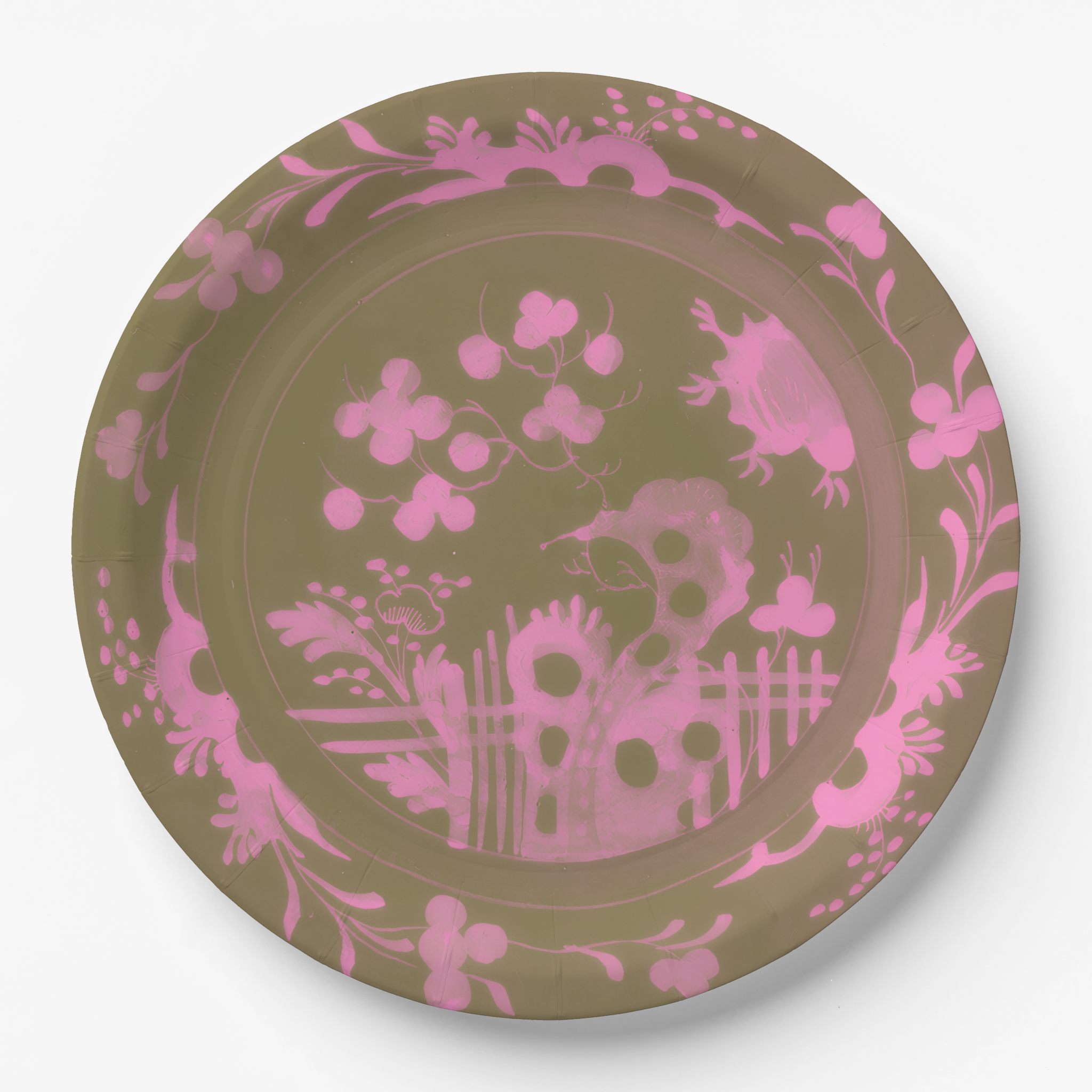
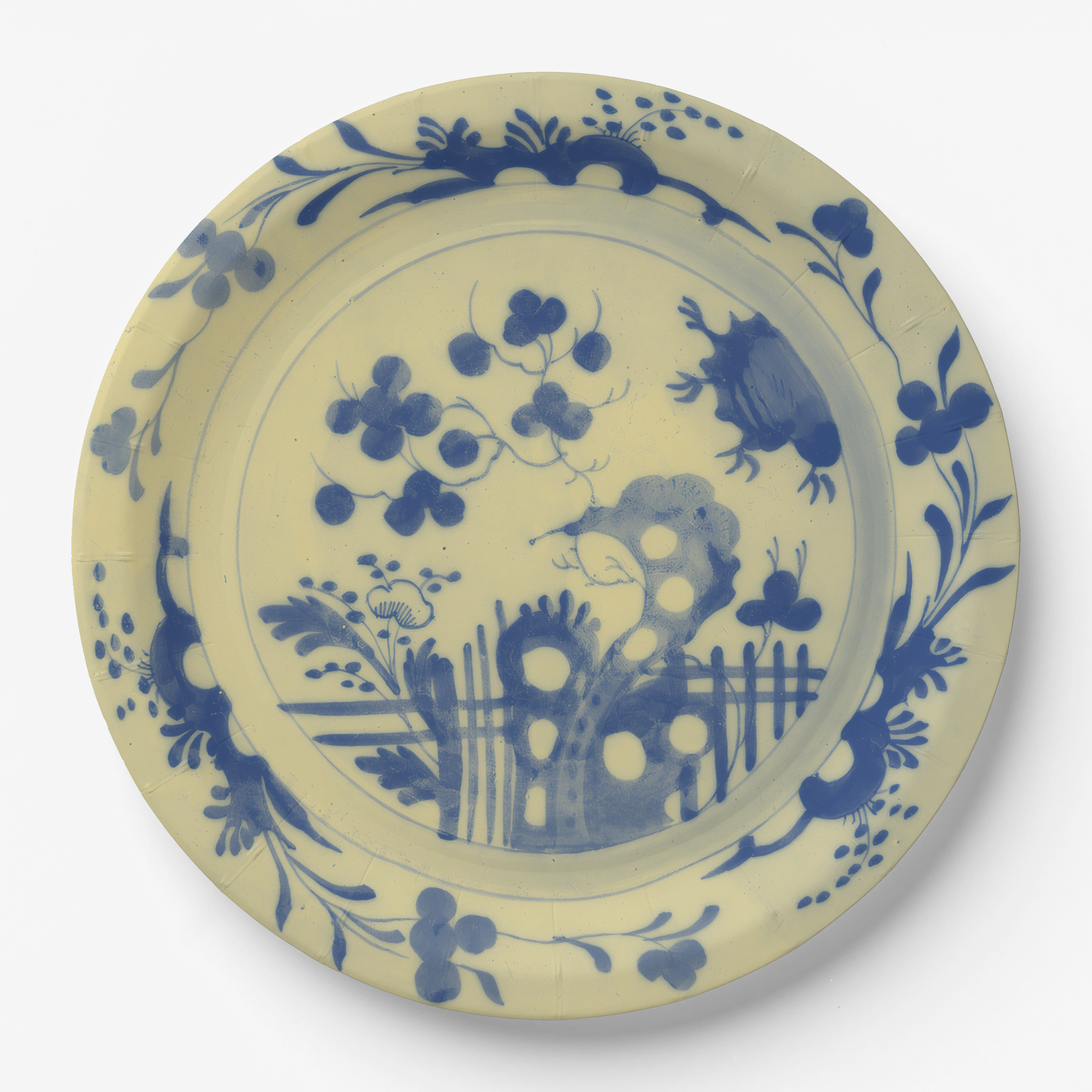
One imagined-East garden scene — blossoming branch, pheasant, and garden fence — drawn from the 18th-century faïence tradition and recoloured across the La Chinoiserie table.
 Pink Chinoiserie Plate Pink Chinoiserie Plate |
 Porcelain Chinoiserie Plate Porcelain Chinoiserie Plate |
 Lagoon Chinoiserie Plate Lagoon Chinoiserie Plate |
 Orange Chinoiserie Plate Orange Chinoiserie Plate |
Porcelain and the Soft-Paste Dream
If faïence gave chinoiserie to the table, porcelain gave it to the cabinet — and here the French were chasing a secret. True hard-paste porcelain was a Chinese monopoly, its recipe unknown in Europe until the Saxons cracked it at Meissen around 1710. France answered with soft-paste porcelain, a beautiful, difficult, artificial substitute, and its early makers turned instinctively to the East for decoration. At Chantilly, founded in 1730 under the protection of Louis-Henri de Bourbon, prince de Condé — an obsessive collector of Japanese porcelain — the first decade of production is frankly Kakiemon: sprigged and asymmetrical, in that clear iron-red and blue-green, with the prince’s beloved Japanese motifs copied straight onto French paste. Mennecy and Saint-Cloud worked the same vein for a clientele that could not get enough of it.
The story runs from there straight to the summit of French luxury. Potters lured away from Chantilly helped start the manufactory at Vincennes, which moved to Sèvres and, under the patronage of Madame de Pompadour and the king himself, absorbed the market for porcelain of the highest refinement. By mid-century the exotic taste that had begun with a demolished tile pavilion had become an instrument of royal prestige — and Pompadour, the presiding intelligence of Louis XV’s court, was its most consequential patron.
Pillement, the Print, and the Painted Wall
A taste becomes a style when it can be copied, and chinoiserie owed its saturation of French interiors to the engraved ornament print. The figure who mattered most was Jean-Baptiste Pillement (1728–1808), a Lyonnais who trained young at the Beauvais tapestry works and then published, from the 1750s, a stream of engraved Chinese ornaments and designs so light, so airy, so endlessly adaptable that they were pirated across Europe and pressed into service on everything — silk and wallpaper, painted panelling and printed cotton, snuffboxes and fans. Pillement is the heir to the chinoiserie of Watteau and Boucher, and the man who put the fantasy into the hands of every provincial decorator with a print in front of him. Through him the imagined East reached the toile-printing works and the painted boiseries, and settled into the fabric of the French room.
A Collector’s Field Guide to French Chinoiserie
The pleasure of collecting chinoiserie is also its central difficulty: the field is a hall of mirrors, in which a French decorator imitated a Chinese original, an English factory later imitated the French, and a nineteenth-century revivalist imitated them all. Learning to stand in the right place in that hall is the whole of the connoisseurship, and a few habits of looking will carry you a long way.
Tell the French from the Chinese. Genuine Chinese export porcelain is harder, whiter, and more evenly potted, its decoration drawn from a settled repertoire with a steady hand; French faïence and soft-paste is warmer in body, often minutely crazed in the glaze, and its chinoiserie is looser, wittier, and more obviously invented. When the scene feels like a stage set rather than a tradition — when the pagoda is a folly and the bird is a fancy — you are almost certainly looking at Europe.
Read the marks, but trust the paste. Chantilly used a hunting-horn mark; Sèvres its interlaced Ls with a date-letter; Rouen and Nevers are largely unmarked and identified by body, palette, and border. Marks were forged in the nineteenth century as readily as they are today, so let the mark corroborate the object rather than certify it: the honesty of the paste, the wear on the footrim, and the character of the painting will tell you more than any painted cipher.
Know where the value hides. The eighteenth-century Chantilly Kakiemon pieces and documented Sèvres are the summit of the market and priced accordingly. The rewarding middle ground — the ground a collection is actually built on — is the eighteenth-century Rouen and Nevers faïence with chinoiserie decoration, and the accomplished nineteenth-century revival wares (Samson of Paris chief among them) that copied the old models with real skill and can be bought for a fraction of the originals, so long as the seller and the price both acknowledge honestly what they are.
Let condition set the price. Faïence chips and its tin glaze flakes at the rim; soft-paste stains and cracks. A little honest wear is the signature of age and no fault at all, but restoration should be disclosed and reflected in the price. On the table or in the cabinet, a warmly imperfect period plate is a better companion than a flawless reproduction — provided you bought it as what it is.
A Note from J.B.
The plate that taught me chinoiserie cost me four euros at the Sunday market in L’Isle-sur-la-Sorgue, and it is not, by any honest reckoning, an important object. It is a nineteenth-century Rouen-style faïence plate, revival rather than period, with a single blue mandarin fishing from a bridge that could not bear his weight, a blossoming branch behind him, and a border of cloud-scrolls painted by someone working quickly and cheerfully at the end of a long tradition. I bought it because the little figure made me smile, which is exactly the reaction the first French decorators were reaching for two hundred years earlier, and it has sat on my kitchen shelf ever since, the least valuable and most-looked-at thing in the house.
What I have come to love about chinoiserie is that it never pretended to be true. The blue-and-white severity of a real Chinese jar is a magnificent thing, but it keeps you at arm’s length; the French version invites you in, winks, and admits that the East it shows you is a place of the imagination — a garden where the birds have impossible tails and the bridges lead nowhere in particular and everyone is having a marvellous time. That is why it belongs on a party table as naturally as in a vitrine. It was always meant to delight before it instructed. Start, if you are starting, with a single blue-and-white piece — a Nevers plate, a Chantilly cup, or, if you would rather set a table than a shelf, a stack of the new plates below. Live with the fantasy for a season, and you will find you have learned to read the real thing without trying.

One table a month, and where it came from — the plates, the napkins, the colours that sit well together, and the archive each pattern was drawn from.

Written by
Jeff M. Barnes
Twenty years collecting 18th- and 19th-century French works and leading small-group sourcing journeys through the markets, fairs, and dealer back rooms of France. The Grammar of Style is the field report from that work.
Keep reading — The Grammar of Style
 Movement MovementLouis XV Read → |
 Movement MovementJaponisme Read → |


