

The Period at a Glance
Le Style Empire
| Dates | c. 1804–1815 · developed during the Consulat from 1799 |
| Key figures | Napoléon I · Charles Percier & Pierre-François-Léonard Fontaine |
| Key makers | Jacob-Desmalter (furniture) · Thomire (bronze) · Sèvres under Brongniart (porcelain) |
| The tell | A synthetic antiquity of authority — the eagle, the bee, the winged Victory, the sphinx — on massive mahogany and fire-gilded bronze |
| Where to see it | Fontainebleau · Musée des Arts Décoratifs · Musée Marmottan Monet · Malmaison |
No decorative style in the history of France was more deliberately conceived as an instrument of power than the Empire. Where Louis XIV had used Versailles to demonstrate the divine sanction of absolute monarchy — to make a building argue a theological point — Napoléon used the decorative arts to make a more audacious claim still: that a Corsican artillery officer who had seized the French state through a coup d’état was the legitimate heir not merely of the French monarchy but of Roman imperial civilization itself, the natural successor to the Cæsars, a man whose victories at Marengo and Austerlitz placed him in a lineage reaching back to Augustus and beyond. The furniture made for his palaces, the silver cast for his table, the textiles woven for his bed-chambers, the porcelain produced by Sèvres under his direction — all of it was enrolled in this argument, made to carry this meaning, designed by men who understood that a console table could be as much a political statement as a speech from the throne.
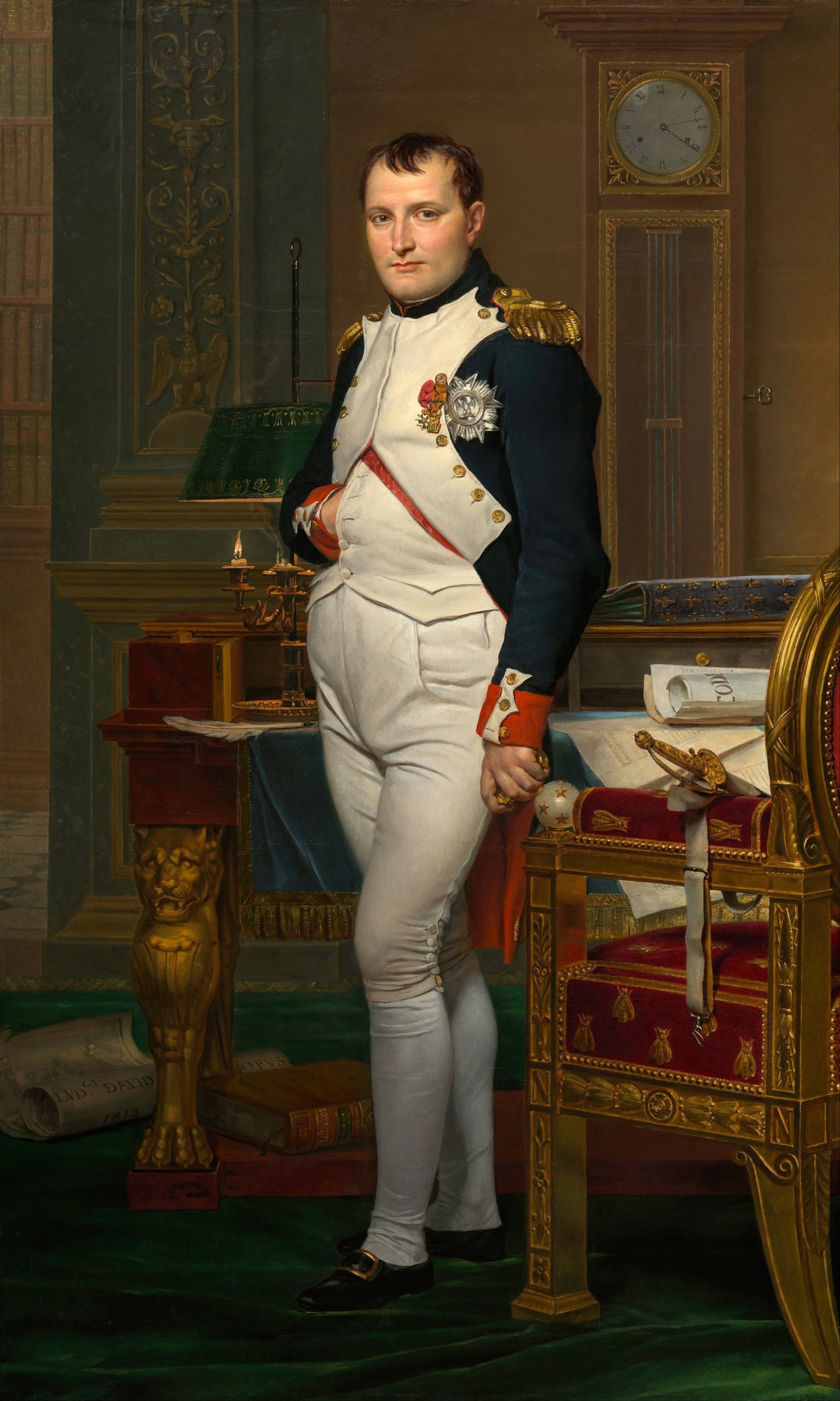
The result is a style of exceptional internal coherence and almost uncomfortable assertiveness — a decorative vocabulary so completely organized around the expression of imperial authority that it can seem, in certain lights, to leave little room for the merely human. And yet the Empire style, properly understood and properly selected, offers the contemporary collector and interior designer something that its detractors consistently undervalue: an aesthetic of unusual psychological weight. The gilt bronze winged victory on a Thomire clock, the porphyry columns of a Percier-designed console, the bee-scattered silk of an imperial bedroom — these are not decorations. They are arguments. And a room that contains them well is a room that has a point of view.
For American collectors, the Empire style presents a particular opportunity. The American market has long engaged with French furniture through the lens of the ancien régime styles — Louis XV, Louis XVI, the transitional Directoire — and has accordingly undervalued the imperial period relative to its European standing. Fine Empire furniture, silver, and decorative objects appear at American auction with some regularity, frequently catalogued by houses whose expertise lies elsewhere, and priced in consequence at levels that would seem remarkable if the same quality were offered in Paris or Brussels. The collector who understands the Empire style is in a position to act on this asymmetry.
From Consulat to Empire: The Making of an Imperial Aesthetic, 1799–1804
The style we call Empire did not begin on the 2nd of December 1804, the day Napoléon placed the crown on his own head in Notre-Dame while Pius VII looked on with an expression that history has variously interpreted as resignation and fury. It had been developing, in the ateliers of the Faubourg Saint-Antoine and in the architectural offices of Charles Percier and Pierre-François-Léonard Fontaine, for the five years of the Consulat that preceded the coronation. Napoléon, who understood the political value of the visual with a clarity unusual even among successful autocrats, had commissioned the refit of the Tuileries and Malmaison almost immediately upon taking power; by 1804, when the Empire was formally proclaimed, the visual grammar of the new regime was already in place.
The architects Percier and Fontaine were the indispensable figures in this process. Their Recueil de décorations intérieures, published in installments from 1801 and collected in the definitive edition of 1812, was the pattern book of the Empire style: a systematic presentation of interior designs, furniture drawings, and decorative details that codified the visual vocabulary Napoléon required and made it available to the craftsmen, ébénistes, and bronze casters who would execute it. The Recueil is one of the most influential documents in the history of the decorative arts; its designs were copied, adapted, and plagiarized across Europe and in America for thirty years after its publication, generating the international Empire style that furnished the houses of the European bourgeoisie from Edinburgh to Warsaw.
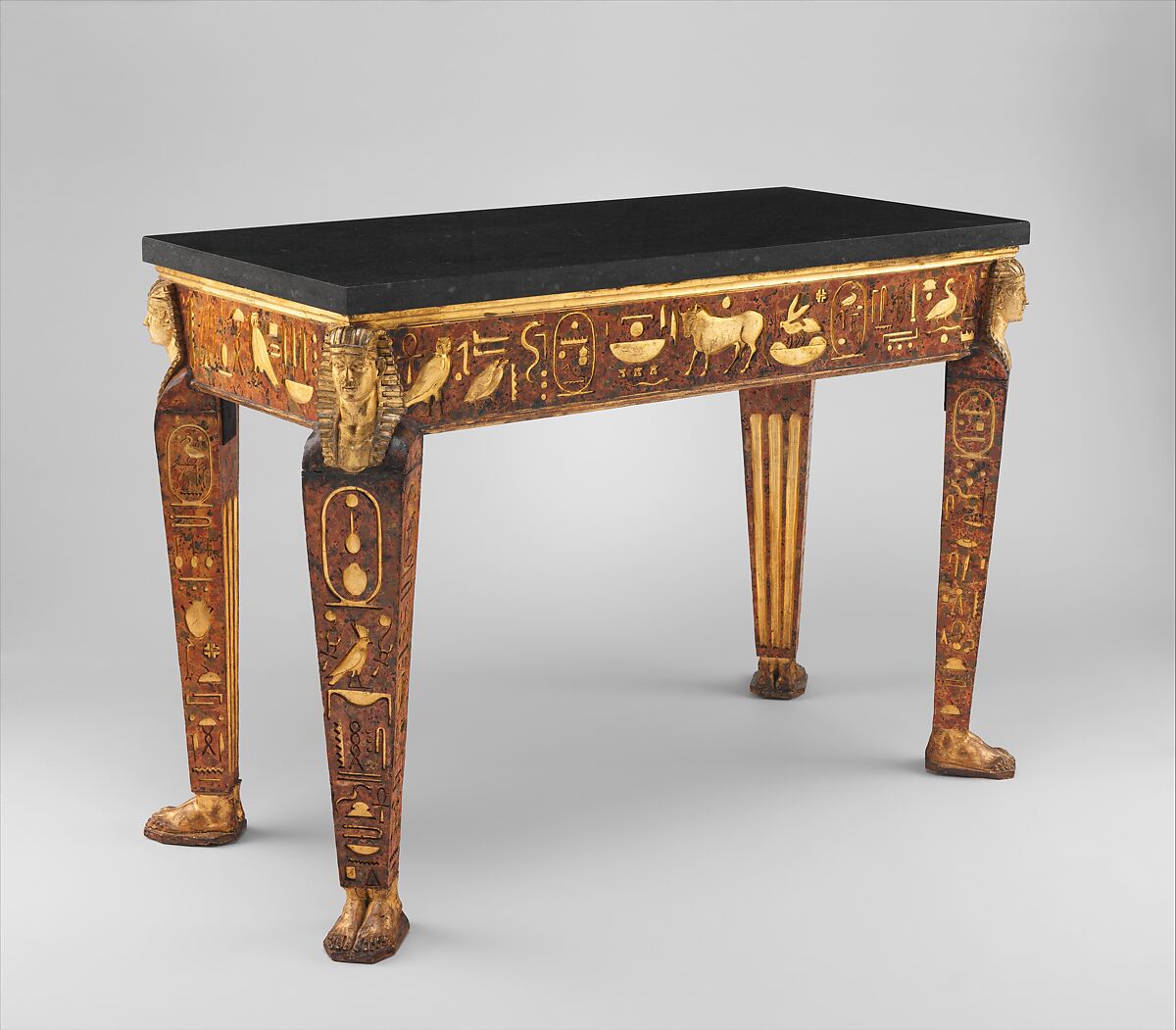
The political and military context of the Empire gave the decorative arts an urgency and a budget that earlier French regimes had rarely provided simultaneously. The Egyptian campaign of 1798–1801, though militarily inconclusive, had returned to France a generation of soldiers, scholars, and artists who had seen the monuments of a civilization three thousand years older than Rome; the Description de l’Égypte, the great scholarly publication that resulted from the campaign, deposited into the European visual imagination a repertoire of sphinxes, lotus columns, caryatids, and hieroglyphic ornament that entered the Empire decorative vocabulary immediately and permanently. The sphinx became as characteristic an Empire motif as the bee or the eagle: a sign of antiquity so deep that it made even Rome look recent.
Bring the look home
Objects in the Empire spirit
Pieces from LIBERTÉ ÉGALITÉ FRATERNITÉ that carry the spirit of Napoleonic France into a modern room.
 Vintage Dandy Costume Greeting Cards Vintage Dandy Costume Greeting Cards |
 Lady Greeting Cards Lady Greeting Cards |
 Le Revolution Bastille Party Le Revolution Bastille Party |
 Liotard Revolutionary Decorative Pillow Liotard Revolutionary Decorative Pillow |
The Grammar of Triumph: Archaeology, Allegory, and the Architecture of Authority
The aesthetic ideology of the Empire style rested on a deliberate conflation of three ancient traditions: the Rome of the Cæsars, the Greece of the classical period, and the Egypt of the pharaohs. Where the Directoire had reached toward classical antiquity with a quality of genuine scholarly inquiry — the klismos chair as an honest attempt to reconstruct a Greek form from vase-painting evidence — the Empire used antiquity as a quarry of symbolic authority, selecting from it the motifs and the formal gestures that most completely expressed the imperial aspiration and combining them without archaeological fastidiousness into a coherent visual language. The result was not historically accurate in any archaeological sense; it was something more interesting, a synthetic antiquity invented for contemporary purposes, as complete and internally consistent as the imperial mythology it was designed to sustain.
The symbolic vocabulary of the Empire style was precisely codified and consistently applied across every medium. The aigle impérial — the Napoleonic eagle, derived from the Roman aquila — appeared on furniture mounts, porcelain services, silk upholstery, and the crowned N monogram that identified imperial property. The bee, claimed by Napoléon as an ancient Frankish symbol predating the fleur-de-lis of the Bourbon monarchy, scattered across imperial textiles as a sign of industry and legitimate succession. Victory figures — winged women derived from the Nike of Samothrace and the representations on Trajan’s Column — populated the gilt bronze mounts of clocks, cabinets, and candelabra. Sphinxes, obelisks, lotus capitals, and the cartouche of Egyptian hieroglyphics grounded the repertoire in the deepest available antiquity. Every object in an Empire interior was, in this sense, a text; the educated visitor to an imperial salon was expected to read it.
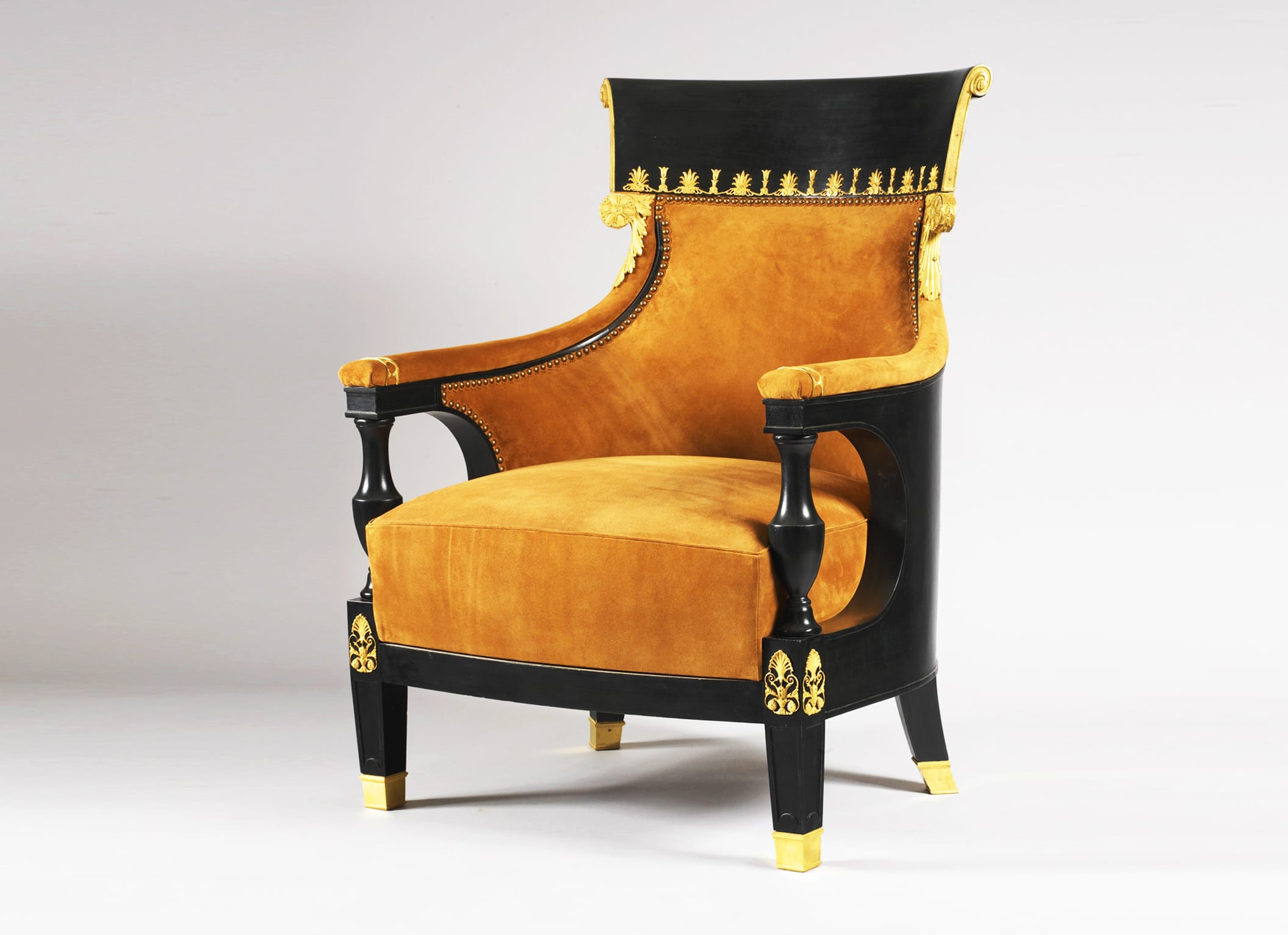
Alongside this explicit symbolism operated a philosophy of scale and material that was equally deliberate. Empire furniture is large — not in the way that Baroque furniture is large, through accumulation of carved and gilded ornament, but in the way that Roman public architecture is large: through a clarity of proportion and a massiveness of primary form that makes the room feel both organized and subordinated. The lit à baldaquin, the bureau plat of monumental mahogany, the console of griotte marble and gilt bronze — these are pieces designed to anchor a room, to establish its center of gravity, to make the architecture respond to them rather than the reverse. A single fine Empire piece, properly placed, can reorganize an entire interior.
Jacob-Desmalter, Thomire, and the Imperial Workshops
The furniture of the Empire period was produced primarily by a small number of workshops whose scale, technical capacity, and direct relationship with the imperial household gave them the resources to execute the ambitions of Percier and Fontaine at the required level. The dominant figure was François-Honoré Jacob-Desmalter (1770–1841), son of Georges Jacob and co-heir with his brother Georges II of the family enterprise that had been the most important menuisier atelier of the Louis XVI period. Jacob-Desmalter — the name adopted after the family purchased the property of Desmalter during the Revolution — operated a workshop on the Rue Méslée capable of employing several hundred craftsmen at its peak; his firm was the primary supplier of furniture to the imperial palaces, producing the beds, consoles, seat furniture, and case pieces that filled the Tuileries, Fontainebleau, Compiègne, and the Palais de l’Élysée under imperial occupation.
The bronze work that animated Empire furniture — the winged victories, sphinxes, caryatids, torch-bearing figures, and military trophies that constituted the decorative program of the mounts — was dominated by the atelier of Pierre-Philippe Thomire (1751–1843), the greatest bronzier of the period and possibly of any period in the French decorative arts. Thomire had trained as a sculptor under Houdon and Pajou before turning to the applied arts; the quality of his bronze work reflects this training in a way that fundamentally distinguishes authentic Empire mounts from the period reproductions that began appearing within twenty years of the First Empire’s fall. A Thomire mount is a sculpture that happens to be a mount: the modeling of the figures, the chasing of the surfaces, the internal consistency of the anatomical detail are those of a sculptor working at the highest level of the tradition, not a craftsman reproducing a design specification.
The Sèvres manufactory, reorganized under the directorship of Alexandre Brongniart in 1800 and operating under direct imperial patronage from the coronation onward, produced the ceramic expression of the Empire style in a range of grandeur and technical ambition unmatched in the history of European porcelain manufacture. Brongniart’s decision to abandon the manufactory’s earlier soft-paste formula in favor of a hard-paste pâte dure was driven precisely by the ambitions of the imperial program: the new formula allowed the production of vases and table services of a scale and a surface quality that the soft-paste tradition could not sustain. The great Sèvres vases étrusques of the Empire period — standing one and a half meters tall, their surfaces painted with Egyptianizing landscapes or scenes from the Napoleonic campaigns — are among the most complete expressions of imperial decorative ideology in any medium.
Furniture, Bronze, Porcelain & the Decorative Arts of the Imperial Period
Furniture: The Architecture of the Imperial Interior
Empire furniture divides into two collecting registers that require separate strategies. The first is the documented imperial atelier piece — the Jacob-Desmalter console with its original Thomire mounts, the lit de repos with a recorded palatial provenance, the secrétaire à abattant whose original delivery receipt survives in the Archives Nationales. These pieces appear at major auction — Christie’s Paris, Sotheby’s Paris, Artcurial — at prices that reflect their institutional rarity and are correctly valued relative to their quality. The second register, and the one that offers genuine collector opportunity, is the broader production of the period’s ébénistes working in the Jacob-Desmalter vocabulary without the direct palatial commission: pieces of unimpeachable quality and period authenticity whose lack of documentary palatial provenance has kept them in a price range accessible to collectors who are not competing with museums. The primary woods of Empire furniture — Brazilian mahogany (acajou), maple, and the exotic veneers of the Consulate and early Empire — are among the most visually satisfying furniture materials in the French tradition; a fine Empire bibliothèque or commode in figured mahogany with its original fire-gilded mounts is a complete visual and material argument for the period that requires nothing additional.
Bronze & Ormolu: The Art of Thomire and His Circle
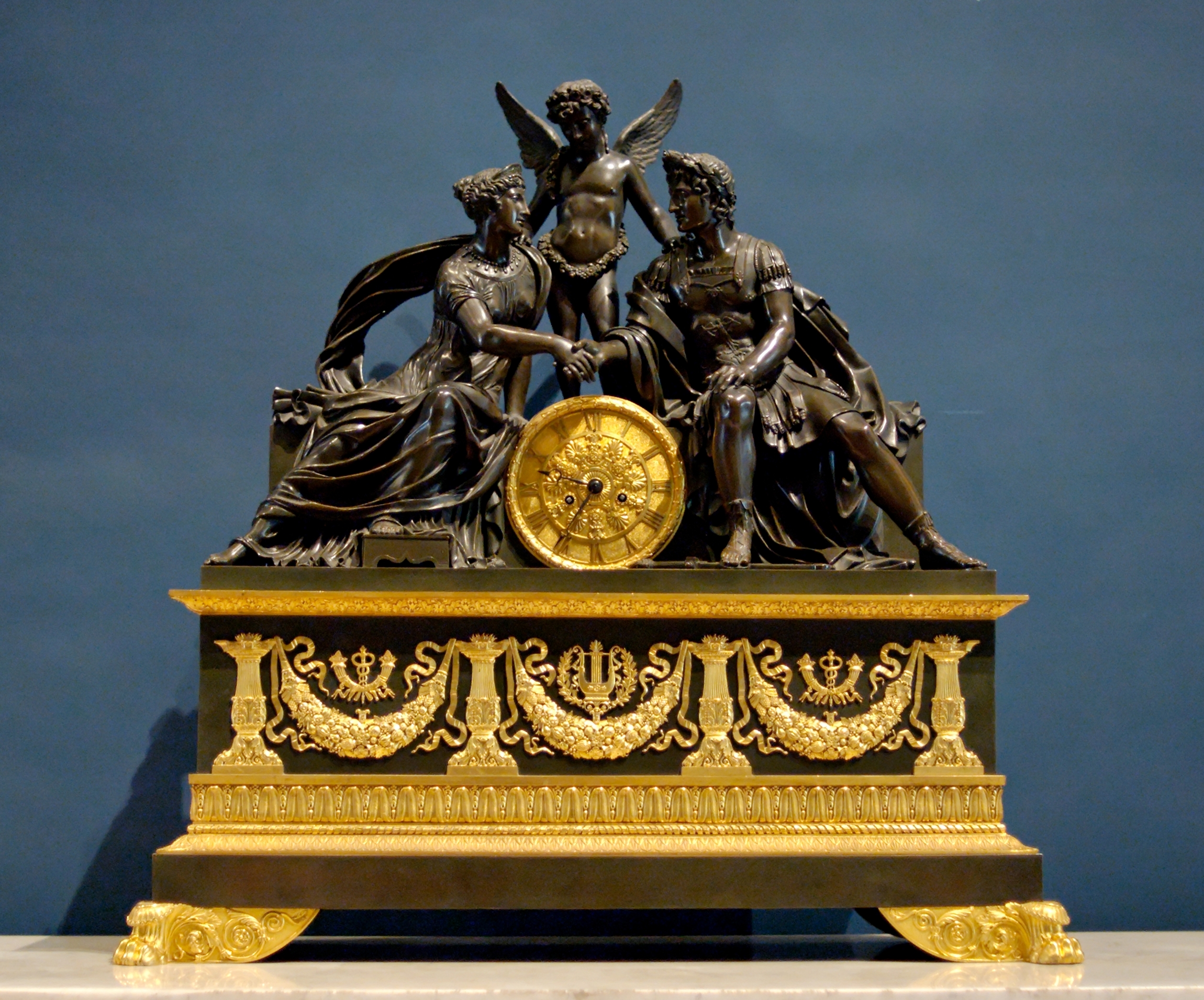
The gilt bronze work of the Empire period is, for the discriminating collector, the most rewarding entry point into the style: rarer than the furniture, less dependent on the condition complications that affect upholstered pieces, and identifiable by criteria — quality of modeling, quality of chasing, richness of fire gilding — that an educated eye can assess at a glance. Thomire’s documented pieces are rare and command prices appropriate to their quality; the broader production of the period’s bronziers, working to the designs of Percier and Fontaine and the pattern books derived from them, offers remarkable quality at prices the market has not yet corrected. Empire clocks, in particular, represent a collecting proposition that serious buyers consistently overlook: a mantel clock of documented Empire date, in patinated bronze and ormolu with a Sevres porcelain dial, combines three of the period’s primary media in a single self-contained object of moderate scale and considerable visual authority. The condition issues that affect upholstery and veneer do not apply; the original fire gilding, distinguishable from later electro-gilding by its warmer color and greater surface depth, is effectively permanent.
Sèvres & Imperial Porcelain: The State’s Finest Medium
The porcelain of the Empire period is organized into three collecting tiers that reflect the hierarchical structure of the imperial gift economy that produced most of the major pieces. At the summit are the great presentation services — the Service des Vues de Rome, the Service Égyptien commissioned in 1808 as a diplomatic gift to Tsar Alexander I, the Service des Quartiers Généraux — whose individual pieces appear at major international auction with sufficient rarity that their appearance constitutes an event. Immediately below these are the individual vases and garnitures produced by Sèvres for sale through the imperial gift program: the vases étrusques, vases fuseau, and vases à oreilles that populated the salons and antichambers of the imperial palaces and were gifted to foreign dignitaries as demonstrations of French industrial and artistic supremacy. The third tier, and the most accessible to the general collector, is the table service production of the period: individual plates, cups, and soucoupes from imperial services, many of which have been separated over two centuries of inheritance and deaccessioning, that can be acquired individually at prices reflecting their divorced-from-service status rather than their inherent quality. A single Sèvres Empire plate, painted with a military trophy or an Egyptianizing landscape in the full hard-paste palette of the Brongniart period, is a complete and self-contained collector’s object.
Textiles, Silver & the Minor Arts of the Imperial Court
The textiles of the Empire period were produced primarily by the Lyon silk manufactory, which Napoléon revived with direct imperial commissions as a deliberate act of industrial policy after the devastation of the revolutionary decade. The resulting silk brocades and lampas — their grounds of imperial purple, Pompeian red, or myrtle green scattered with bees, laurel wreaths, the letter N, or the Egyptianizing ornament of the campaign palette — are among the most visually authoritative textiles produced in the history of European manufacture, and the finest surviving examples in documentable condition are held by museums and institutional collections that rarely deaccession them. For the practical collector, period fragments and individual lengths appear at specialized textile auctions and through the dealers of the Marché Paul Bert who have cultivated relationships with the provincial houses where estate dispersals still surface original Empire furnishing textiles. The silver of the Empire period, produced by the leading orfèvres of the Consulate and Empire — Martin-Guillaume Biennais, Henry Auguste — is the most directly wearable expression of the style’s formal ambitions: flatware and hollowware whose proportions, applied ornament, and material weight make the best Regency and George IV English silver look almost provincial in comparison.
A Collector’s Field Guide to the Empire Style
Reading the Object: Authentication Markers
The authentication of Empire furniture turns on three primary criteria: the quality and method of the bronze mounts, the nature of the mahogany veneer, and the construction details of the carcass. Fire-gilded (doré au mercure) mounts — the mercury gilding process banned in France in 1830 — are the single most reliable dating indicator for Empire bronzes; the process produced a gilded surface of a warmth, depth, and surface texture that electro-gilding, introduced in the 1840s, does not replicate at any quality level. The mahogany of genuine Empire pieces is primarily Cuban or Brazilian acajou with a figure and density that differs perceptibly from the African mahogany used in later reproductions. The interior construction of Empire case furniture — the secondary woods of the carcass, the method of drawer construction, the tool marks on unfinished interior surfaces — follows conventions that a competent specialist can read with confidence. The most common error in Empire authentication is the misidentification of high-quality Charles X and Louis-Philippe revival pieces — made in the 1820s through 1840s in close imitation of the Empire vocabulary — as genuine First Empire; the construction details and the material quality of the mounts are the most reliable discriminators.
The Market in 2026: Why Empire Remains Strategically Undervalued in America
The French Empire market presents a geographic asymmetry that the well-informed American collector can exploit systematically. In Paris, at Artcurial and at the specialist dealers of the Carré Rive Gauche and the Marché Serpette, fine Empire furniture is accurately priced relative to its quality: the market there is deep, the expertise concentrated, and the competition from Belgian, Dutch, and German collectors consistent. In the American market — at the regional auction houses of the Northeast and the South, in the inventories of generalist antique dealers who have acquired Empire pieces through estate dispersals without the expertise to identify and price them precisely — the same quality appears regularly at prices thirty to fifty percent below its Paris equivalent. The collector who cultivates the American secondary market with the knowledge of a Paris specialist is in a position that the French market itself cannot offer. The condition question is more variable in the American market — pieces that arrived in the United States in the nineteenth century have frequently been reupholstered, refinished, and altered in ways that affect value — but the underlying quality of the primary woods and the bronze work is unaffected by subsequent interventions that a good restorer can address.
Where to Look: Paris Sourcing Geography
The primary Paris venues for Empire material are organized by price tier and provenance quality. For the highest-quality documented pieces, the semi-annual sales at Artcurial — particularly the Mobilier, Arts Décoratifs et Tableaux sales — and the specialist sales at Christie’s Paris and Sotheby’s Paris are the correct starting point; preview days at these sales provide an education in quality benchmarks that no amount of book study can replace. For the broader market, the Carré Rive Gauche galleries — concentrated on the Rue de Beaune, the Rue de Lille, and the Quai Voltaire — hold several dealers specializing in the Empire and Restauration periods whose inventories are consistently worth examining. At the Marché Paul Bert and Marché Serpette at Saint-Ouen, the Empire material is less concentrated than the Louis XV and XVI, but the specialist dealers who know the period are present and their prices reflect the fact that they are selling to an international trade clientele rather than a retail collector audience. The provincial auction houses of Lyon and Bordeaux, where the négoce families of the Napoleonic era furnished their houses in the full Empire vocabulary, continue to surface documented regional pieces with excellent provenance at prices that have not been subject to the Parisian premium.
Bringing It Home: US Import, Mahogany & CITES
Genuine First Empire furniture (1804–1815) is more than 200 years old and qualifies without complication for duty-free import into the United States under the antiques provision. The documentation to request from any serious Paris dealer or auction house is standard: a written receipt describing the piece with its approximate date and country of origin, provenance photographs, and for significant purchases a formal expertise from a recognized specialist or auction house. The CITES complication for Empire is specifically the mahogany question. The primary timber of Empire furniture is Caribbean mahogany — Swietenia mahagoni (Cuban) or Swietenia macrophylla (Brazilian) — both of which appear on CITES Appendix II, requiring documentation of legal origin for international trade. For furniture of documented age over 100 years, the CITES exemption for antiques applies and simplifies the process considerably; request from your dealer the documentation confirming antique status, and ensure your shipping agent — who should be a firm with specific experience in transatlantic antique shipment — prepares the CITES antiques declaration correctly. Any Empire piece incorporating ivory — escutcheons, inlaid banding, sculptural mounts — requires additional CITES documentation under current US Fish and Wildlife Service regulations; consult with your customs specialist before purchase rather than after.
Living Inside the Empire: The Tuileries, Fontainebleau, and the Imperial Geography of Paris
The Empire style was designed to be experienced at scale, in the rooms for which it was made, and the most vivid surviving context for that experience is not a museum — though the Musée des Arts Décoratifs provides the finest institutional survey — but the palace of Fontainebleau, forty-five minutes south of Paris by train from the Gare de Lyon. Fontainebleau is the single most complete surviving Empire interior ensemble in the world: the appartements of Napoléon and Joséphine, the Salle du Trône, the Salon de l’Abdication where the emperor signed his first abdication in April 1814, retain their original Empire furnishings, textiles, and bronze work in a state of preservation that the Louvre and the palace of Versailles — both of which were stripped and refurnished multiple times during the nineteenth century — cannot match. To spend a morning in the imperial apartments at Fontainebleau is to understand the Empire style as a total environment rather than as a collection of individual objects: the relationship between the furniture scale, the textile color, the bronze quantity, and the room architecture that Percier and Fontaine calibrated so precisely becomes legible only when all of it is present simultaneously.
In Paris itself, the essential Empire monument is the Musée Marmottan Monet in the 16th arrondissement, whose founding collection was assembled by Jules Marmottan specifically around Empire furniture and decorative arts and which retains, in its original first-floor salon and salle de chasse, an ensemble of furniture, bronzes, and decorative objects of the Consulate and Empire periods that no other Paris museum matches for density and coherence. The Musée des Arts Décoratifs on the Rue de Rivoli supplements this with the finest study collection of Empire furniture in any institutional context — including a Jacob-Desmalter lit en bateau of documented imperial provenance — and with the research library and print room whose holdings of Percier and Fontaine drawings and Empire-period pattern books constitute the essential scholarly resource for any collector working seriously in the field.
The Malmaison — Napoléon’s country house west of Paris at Rueil, purchased with Joséphine in 1799 and furnished under her direct supervision with the collaboration of Percier and Fontaine — completes the essential Empire itinerary. It is a more intimate scale than Fontainebleau, its rooms proportioned for habitation rather than ceremony, and the collection of Empire furniture and decorative arts it holds reflects Joséphine’s particular aesthetic intelligence — more responsive to the Egyptian material, more interested in the botanical and natural history references that run through the Empire decorative vocabulary, more willing to allow beauty its claims alongside authority. The rose garden she created there, whose varieties were documented by the botanical painter Pierre-Joseph Redouté in watercolors that remain among the finest botanical images ever produced, is itself an Empire decorative work: a garden designed with the same principles of clarity, abundance, and deliberate symbolic loading that organized the interior spaces of the palaces.
A Note from Jeff
My first serious encounter with Empire was not in Paris but in New Orleans, at an estate sale in the Garden District in the late 1990s, where a set of twelve Jacob-Desmalter dining chairs — their mahogany original, their mounts fire-gilded and intact, their upholstery a disaster of mid-century green vinyl — was catalogued as “French, 19th century” and priced accordingly. I had been in Paris enough by then to know what I was looking at, or at least to suspect it; the construction details confirmed it, and the chairs came home with me at a number I will not disclose because it still seems improbable.
What those chairs taught me, and what twenty years of looking at Empire furniture has deepened into something closer to conviction, is that the style’s reputation for coldness and assertion is a misreading produced by encountering it in the wrong context — in museum rooms organized for maximum symbolic legibility rather than for daily habitation, or in the auction catalog photographs that emphasize the bronze work and flatten the material quality of the mahogany into something merely brown. In a room of appropriate scale and proportion, with the light that the period’s interiors were designed to receive — the grey northern light of a Paris apartment, the warm lateral light of a New Orleans Garden District house — good Empire furniture has a quality of psychological solidity that I find more sustaining than almost any other French period style. It does not charm or seduce. It simply occupies its space with an absolute assurance, and after twenty years of living with it, I find that assurance not oppressive but clarifying.
The American market continues to undervalue it. I have no reliable theory for why this should be — the scale is appropriate to American rooms, the quality is unimpeachable, the price differential from equivalent Louis XVI material is significant and in the wrong direction — but I have long since stopped complaining and started buying. Go and look while the asymmetry persists.

One letter a month on the French table: one table, the pieces on it, and where each pattern came from.
Own a shop or design studio? Open a wholesale account →

Written by
Jeff M. Barnes
Twenty years collecting 18th- and 19th-century French works and leading small-group sourcing journeys through the markets, fairs, and dealer back rooms of France. The Grammar of Style is the field report from that work.
Instagram Pinterest YouTube TikTok Threads Facebook LinkedIn
Keep reading — The Grammar of Style
 Movement MovementDirectoire Read → |
 Movement MovementThe Bourbon Restoration Read → |


